<?xml version="1.0" encoding="utf-8"?><feed xmlns="http://www.w3.org/2005/Atom" ><generator uri="https://jekyllrb.com/" version="3.10.0">Jekyll</generator><link href="https://mobydex.org/feed.xml" rel="self" type="application/atom+xml" /><link href="https://mobydex.org/" rel="alternate" type="text/html" /><updated>2026-09-15T19:35:37+00:00</updated><id>https://mobydex.org/feed.xml</id><title type="html">Moby Dex</title><subtitle>Moby Dex.</subtitle><entry><title type="html">Erfolgreiches Abschlusstreffen des Projekts Moby Dex</title><link href="https://mobydex.org/news/2026/08/20/successful_completion.html" rel="alternate" type="text/html" title="Erfolgreiches Abschlusstreffen des Projekts Moby Dex" /><published>2026-08-20T05:00:00+00:00</published><updated>2026-08-20T05:00:00+00:00</updated><id>https://mobydex.org/news/2026/08/20/successful_completion</id><content type="html" xml:base="https://mobydex.org/news/2026/08/20/successful_completion.html"><![CDATA[<p>Mit einem gemeinsamen Abschlusstreffen bei der CAS Software AG in Karlsruhe haben die Projektpartner das Forschungs- und Entwicklungsprojekt Moby Dex erfolgreich beendet. Nach drei Jahren intensiver Zusammenarbeit bot die Veranstaltung Gelegenheit, die erreichten Ergebnisse zusammenzufassen, Erfahrungen aus den verschiedenen Arbeitspaketen auszutauschen und die Perspektiven für die weitere Nutzung der entwickelten Lösungen zu diskutieren.</p>

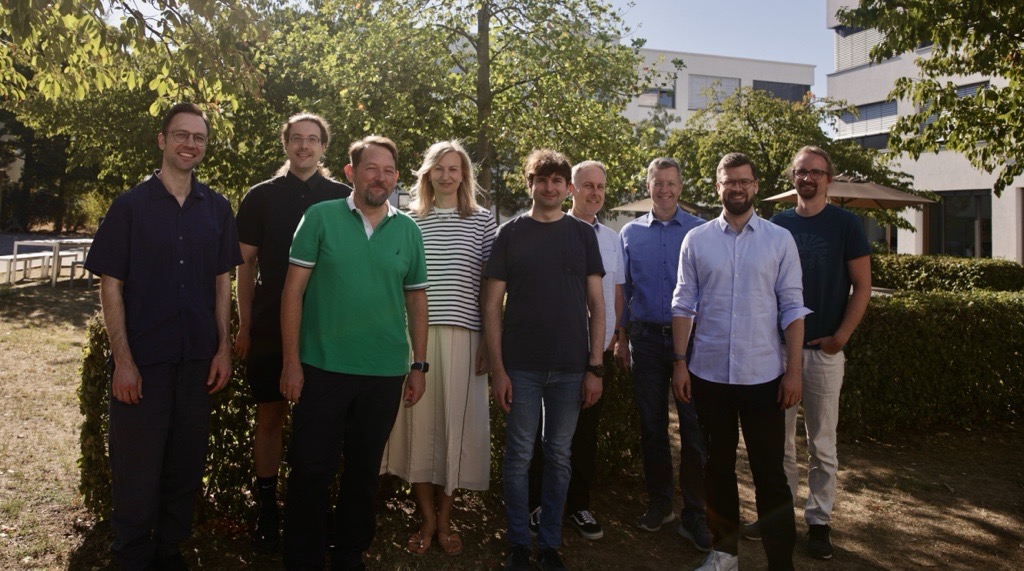
<p><img src="/assets/images/20260813-group-photo.jpeg" alt="Das MobyDex-Konsortium beim Abschlusstreffen in Karlsruhe." style="display:block; margin-left:auto; margin-right:auto; max-height: 400px; max-width: 100%;" /></p>

<p>Im Mittelpunkt des Treffens stand ein Rückblick auf die gemeinsame Projektarbeit. Die Projektpartner reflektierten die Entwicklung der MobyDex-Plattform, die Zusammenführung von Mobilitätsangebots- und Mobilitätsbedarfsdaten sowie die erzielten Fortschritte bei der Entwicklung datengetriebener Analyse- und Bewertungsverfahren. Dabei wurde deutlich, dass die enge Zusammenarbeit von Forschungseinrichtungen und Unternehmen eine wesentliche Grundlage für den Projekterfolg war.</p>

<p>Die Veranstaltung diente zudem dazu, die im Projekt gewonnenen Erkenntnisse zu dokumentieren und die nächsten Schritte für die Verwertung und Weiterentwicklung der Ergebnisse abzustimmen. Besonderes Augenmerk lag auf den Möglichkeiten, die entwickelten Methoden und Plattformkomponenten künftig in weiteren Anwendungsfeldern der Mobilitätsplanung einzusetzen und bestehende Kooperationen fortzuführen.</p>

<p>Mit dem erfolgreichen Abschluss endet die Förderphase von Moby Dex. Gleichzeitig bilden die entstandenen Technologien, Datenmodelle und Netzwerke eine wertvolle Grundlage für zukünftige Forschungs- und Entwicklungsaktivitäten im Bereich der datengetriebenen Mobilität.</p>

<p>Das MobyDex-Konsortium bedankt sich bei allen Projektpartnern, assoziierten Partnern, Datenbereitstellern sowie weiteren Unterstützerinnen und Unterstützern für die vertrauensvolle und konstruktive Zusammenarbeit während der vergangenen drei Jahre. Der gemeinsame Austausch zwischen Wissenschaft, Wirtschaft, Mobilitätsanbietern, Planungsträgern und öffentlichen Einrichtungen hat wesentlich zum Erfolg des Projekts beigetragen und die Entwicklung praxisnaher Lösungen für eine bedarfsgerechte und nachhaltige Mobilität ermöglicht.</p>]]></content><author><name>Marcus Handte</name></author><category term="news" /><summary type="html"><![CDATA[Nach drei Jahren gemeinsamer Forschung hat das MobyDex-Konsortium sein Projekt erfolgreich abgeschlossen und wichtige Grundlagen für datengetriebene, bedarfsgerechte Mobilitätsplanung geschaffen.]]></summary></entry><entry><title type="html">Successful Final Meeting of the Moby Dex Project</title><link href="https://mobydex.org/en/news/2026/08/20/successful_completion.html" rel="alternate" type="text/html" title="Successful Final Meeting of the Moby Dex Project" /><published>2026-08-20T05:00:00+00:00</published><updated>2026-08-20T05:00:00+00:00</updated><id>https://mobydex.org/en/news/2026/08/20/successful_completion</id><content type="html" xml:base="https://mobydex.org/en/news/2026/08/20/successful_completion.html"><![CDATA[<p>With a joint final meeting hosted by CAS Software AG in Karlsruhe, the project partners successfully concluded the Moby Dex research and development project. After three years of intensive collaboration, the event provided an opportunity to summarize the project’s achievements, exchange experiences from the various work packages, and discuss prospects for the further use of the developed solutions.</p>

<p><img src="/assets/images/20260813-group-photo.jpeg" alt="The MobyDex consortium at the final meeting in Karlsruhe." style="display:block; margin-left:auto; margin-right:auto; max-height: 400px; max-width: 100%;" /></p>

<p>The meeting focused on reflecting on the joint project work. The partners reviewed the development of the MobyDex platform, the integration of mobility supply and mobility demand data, and the progress achieved in the development of data-driven analysis and evaluation methods. It became clear that the close cooperation between research institutions and industry partners was a key factor in the project’s success.</p>

<p>The event also served to document the knowledge gained throughout the project and to coordinate the next steps for the exploitation and further development of the results. Particular attention was given to opportunities for applying the developed methods and platform components in additional mobility planning scenarios and for continuing the established collaborations.</p>

<p>With the successful completion of the project, the funding phase of Moby Dex has come to an end. At the same time, the technologies, data models, and networks created during the project provide a valuable foundation for future research and development activities in the field of data-driven mobility.</p>

<p>The MobyDex consortium would like to thank all project partners, associated partners, data providers, and other supporters for their trustful and constructive cooperation throughout the past three years. The continuous exchange between academia, industry, mobility service providers, planning authorities, and public institutions made a significant contribution to the success of the project and enabled the development of practical solutions for demand-oriented and sustainable mobility.</p>]]></content><author><name>Marcus Handte</name></author><category term="news" /><summary type="html"><![CDATA[After three years of collaborative research, the MobyDex consortium has successfully completed the project, establishing key foundations for data-driven and demand-oriented mobility planning.]]></summary></entry><entry><title type="html">Moby Dex Projektabschluss</title><link href="https://mobydex.org/news/2026/08/01/mobydex_completion.html" rel="alternate" type="text/html" title="Moby Dex Projektabschluss" /><published>2026-08-01T05:00:00+00:00</published><updated>2026-08-01T05:00:00+00:00</updated><id>https://mobydex.org/news/2026/08/01/mobydex_completion</id><content type="html" xml:base="https://mobydex.org/news/2026/08/01/mobydex_completion.html"><![CDATA[<p>Nach drei Jahren Forschung und Entwicklung erreicht Moby Dex seinen Abschluss. Das Projekt hat eine datengetriebene Plattform entwickelt, die Mobilitätsangebot und Mobilitätsbedarf systematisch analysiert und damit neue Grundlagen für eine bedarfsgerechte und nachhaltige Mobilitätsplanung schafft.</p>

<p>Die Ergebnisse werden im Rahmen der offiziellen Abschlussveranstaltung am Donnerstag, den 13. August, von 9-15 Uhr bei der CAS Software AG in Karlsruhe vorgestellt.</p>

<p>Neben Vorträgen und Ergebnispräsentationen erwartet die Teilnehmenden ein besonderer Programmpunkt: Live-Demonstrationen der im Projekt entwickelten Prototypen. Dabei werden die unterschiedlichen Anwendungsfälle und Werkzeuge des MobyDex-Ökosystems vorgestellt und praxisnah demonstriert. Besucherinnen und Besucher erhalten Einblicke in innovative Ansätze zur Analyse von Mobilitätsangeboten und -bedarfen, zur regionalen Mobilitätsplanung sowie zum betrieblichen Mobilitätsmanagement.</p>

<p>Die Veranstaltung bietet die Gelegenheit, die Projektergebnisse kennenzulernen, mit den beteiligten Projektpartnern ins Gespräch zu kommen und einen Blick auf die Potenziale datengetriebener Mobilitätslösungen für die Verkehrswende zu werfen.</p>

<p>Wir freuen uns auf eine spannende Abschlussveranstaltung in Karlsruhe.</p>]]></content><author><name>Marcus Handte</name></author><category term="news" /><summary type="html"><![CDATA[Am 13. August findet die Abschlussveranstaltung in Karlsruhe statt.]]></summary></entry><entry><title type="html">Moby Dex Project Completion</title><link href="https://mobydex.org/en/news/2026/08/01/mobydex_completion.html" rel="alternate" type="text/html" title="Moby Dex Project Completion" /><published>2026-08-01T05:00:00+00:00</published><updated>2026-08-01T05:00:00+00:00</updated><id>https://mobydex.org/en/news/2026/08/01/mobydex_completion</id><content type="html" xml:base="https://mobydex.org/en/news/2026/08/01/mobydex_completion.html"><![CDATA[<p>After three years of research and development, Moby Dex is reaching its conclusion. The project has developed a data-driven platform that systematically analyzes mobility supply and mobility demand, creating a new foundation for needs-based and sustainable mobility planning.</p>

<p>The project results will be presented at the official final event on Thursday, August 13, from 9:00 AM to 3:00 PM, hosted by CAS Software AG in Karlsruhe.</p>

<p>In addition to presentations and project result showcases, participants can look forward to a special highlight: live demonstrations of the prototypes developed during the project. The various use cases and tools of the Moby Dex ecosystem will be presented and demonstrated in a practical setting. Visitors will gain insights into innovative approaches for analyzing mobility supply and demand, supporting regional mobility planning, and enabling corporate mobility management.</p>

<p>The event provides an opportunity to explore the project outcomes, engage with the project partners, and gain a deeper understanding of the potential of data-driven mobility solutions to support the mobility transition.</p>

<p>We look forward to an exciting final event in Karlsruhe.</p>]]></content><author><name>Marcus Handte</name></author><category term="news" /><summary type="html"><![CDATA[The final project event will take place in Karlsruhe on August 13.]]></summary></entry><entry><title type="html">Moby Dex auf der FOSSGIS</title><link href="https://mobydex.org/news/2026/03/26/fossgis.html" rel="alternate" type="text/html" title="Moby Dex auf der FOSSGIS" /><published>2026-03-26T09:00:00+00:00</published><updated>2026-03-26T09:00:00+00:00</updated><id>https://mobydex.org/news/2026/03/26/fossgis</id><content type="html" xml:base="https://mobydex.org/news/2026/03/26/fossgis.html"><![CDATA[<p>Dr. Christopher Frank von der CISS TDI GmbH hat Moby Dex auf der FOSSGIS 2026 in Göttingen vertreten. Die FOSSGIS 2026 bot für Moby Dex die Gelegenheit, das Projekt im Umfeld der Open-Source-GIS-Community vorzustellen und den fachlichen Austausch zu Geodaten, QGIS und datenbasierter Infrastrukturplanung zu vertiefen. Der Besuch in Göttingen war geprägt von zahlreichen Gesprächen mit Fachleuten aus Praxis, Wissenschaft und Verwaltung und lieferte wertvolle Impulse für die weitere Projektarbeit.</p>

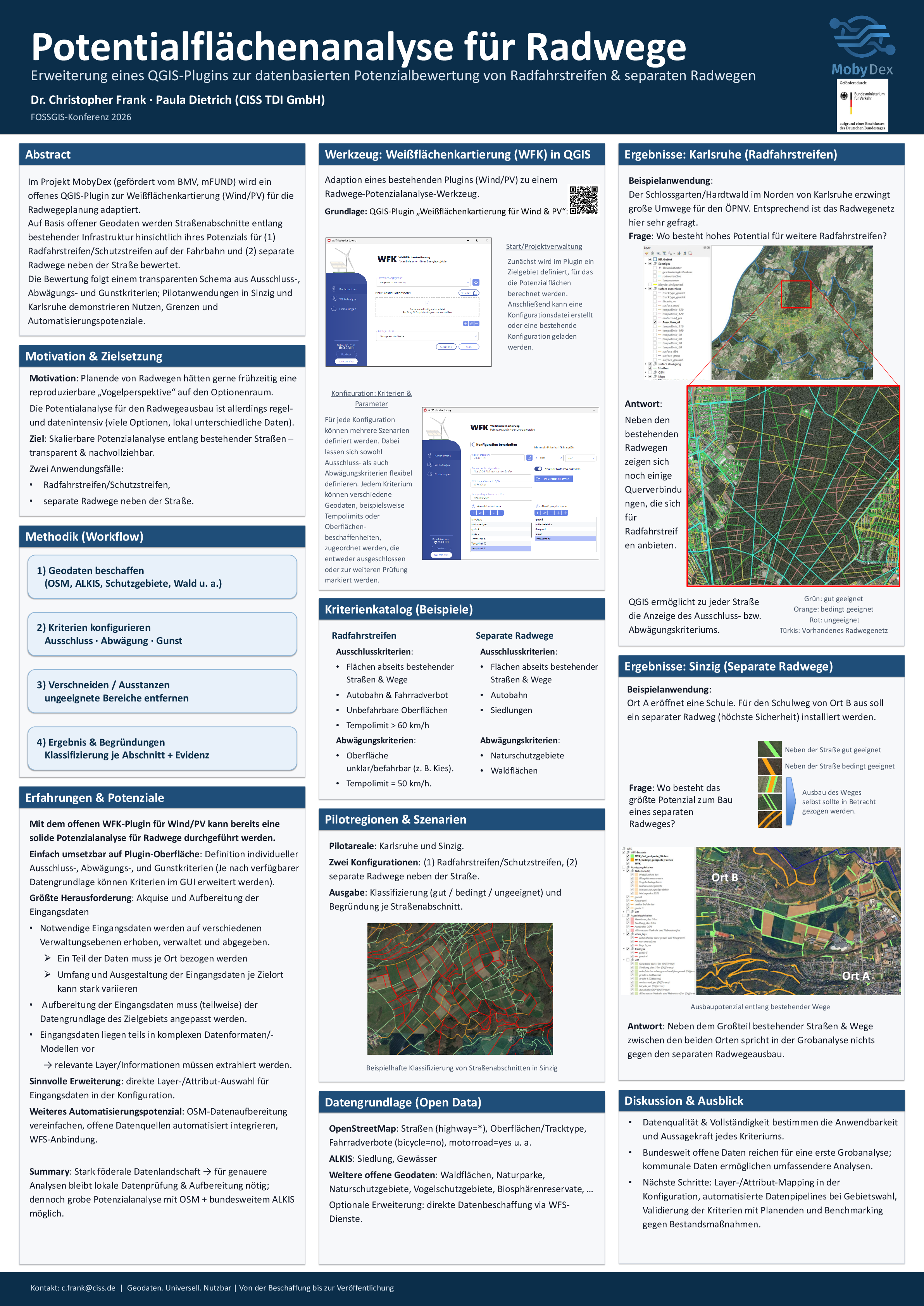
<p>Im Rahmen der Posterausstellung wurde am 26. März 2026 der Beitrag „Potentialflächenanalyse für Radwege: Erweiterung eines QGIS-Plugins für Wind- und PV“ präsentiert. Im Projekt Moby Dex wird das offene QGIS-Plugin zur Weißflächenkartierung für Wind- und PV-Anlagen für die Radwegeplanung adaptiert und erweitert. Ziel ist es, Straßenabschnitte entlang bestehender Infrastruktur auf Basis offener Geodaten im Hinblick auf ihr Potenzial für Radfahrstreifen, Schutzstreifen und separate Radwege zu bewerten.</p>

<p><a href="/assets/images/FOSSGIS_Poster_481u77V.pdf"><img src="/assets/images/FOSSGIS_Poster_481u77V.png" alt="FOSSGIS Poster" height="320" style="display:block; margin-left:auto; margin-right:auto" /></a></p>

<p>Die Methodik folgt einem transparenten Schema aus Ausschluss-, Abwägungs- und Gunstkriterien. Berücksichtigt werden unter anderem Straßeneigenschaften, verfügbare Flächen, Schutzgebiete sowie weitere offene Geodatenquellen. Das QGIS-Plugin soll eine skalierbare und reproduzierbare Potenzialanalyse ermöglichen und damit Planungsprozesse datenbasiert unterstützen.</p>

<p>Auf dem Poster wurden zudem Erfahrungen aus den Pilotregionen Sinzig und Karlsruhe vorgestellt. Sie zeigen, dass sich mit dem adaptierten Werkzeug bereits eine belastbare Grobanalyse durchführen lässt, zugleich aber die Qualität und Verfügbarkeit lokaler Eingangsdaten entscheidend für Genauigkeit und Tiefe der Bewertung bleibt.</p>

<p>Besonders wertvoll war das zahlreiche positive Feedback aus dem Kreis von Städten und Kommunen. Die Rückmeldungen haben bestätigt, dass für datenbasierte und nachvollziehbare Werkzeuge zur Unterstützung der Radverkehrsplanung ein hoher praktischer Bedarf besteht. Darüber hinaus ergaben sich aus den Gesprächen konkrete Anregungen für sinnvolle Erweiterungen der bislang betrachteten Abwägungskriterien.</p>

<p>Der Besuch der FOSSGIS 2026 hat damit nicht nur die Sichtbarkeit von Moby Dex im Open-Source-Umfeld gestärkt, sondern auch wertvolle fachliche Impulse für die weitere Projektarbeit geliefert. Vielen Dank an Teilnehmer und Veranstalter der FOSSGIS.</p>]]></content><author><name>Dr. Christopher Frank</name></author><category term="news" /><summary type="html"><![CDATA[Moby-Dex auf der FOSSGIS 2026 in Göttingen: Vorstellung der Adaptierung eines QGIS-Plugins für die Radwegeplanung und positive Rückmeldungen aus der Praxis.]]></summary></entry><entry><title type="html">Moby Dex at FOSSGIS</title><link href="https://mobydex.org/en/news/2026/03/26/fossgis.html" rel="alternate" type="text/html" title="Moby Dex at FOSSGIS" /><published>2026-03-26T09:00:00+00:00</published><updated>2026-03-26T09:00:00+00:00</updated><id>https://mobydex.org/en/news/2026/03/26/fossgis</id><content type="html" xml:base="https://mobydex.org/en/news/2026/03/26/fossgis.html"><![CDATA[<p>Dr. Christopher Frank from CISS TDI GmbH represented Moby Dex at FOSSGIS 2026 in Göttingen. FOSSGIS 2026 provided Moby Dex with the opportunity to present the project within the open-source GIS community and to deepen the technical exchange on geodata, QGIS, and data-driven infrastructure planning. The visit to Göttingen was characterized by numerous conversations with experts from practice, science, and administration and provided valuable impulses for further project work.</p>

<p>As part of the poster exhibition, the contribution “Potentialflächenanalyse für Radwege: Erweiterung eines QGIS-Plugins für Wind- und PV”<sup>1</sup> was presented on March 26, 2026. In the Moby Dex project, the open QGIS plugin for white space mapping for wind and PV installations is being adapted and extended for cycle path planning. The goal is to evaluate road sections along existing infrastructure based on open geodata with regard to their potential for cycle lanes, protected lanes, and separate cycle paths.</p>

<p><a href="/assets/images/FOSSGIS_Poster_481u77V.pdf"><img src="/assets/images/FOSSGIS_Poster_481u77V.png" alt="FOSSGIS Poster" height="320" style="display:block; margin-left:auto; margin-right:auto" /></a></p>

<p>The methodology follows a transparent scheme of exclusion, weighing, and preference criteria. Among other things, road characteristics, available areas, protection areas, and other open geodata sources are taken into account. The QGIS plugin is intended to enable a scalable and reproducible analysis of potential sites for Bicycle Paths and thus support data-driven planning processes.</p>

<p>On the poster, experiences from the pilot regions of Sinzig and Karlsruhe were also presented. They show that the adapted tool already enables a reliable coarse analysis, while the quality and availability of local input data remain crucial for the accuracy and depth of the assessment.</p>

<p>Particularly valuable was the numerous positive feedback from cities and municipalities. The feedback confirmed that there is high practical demand for data-driven and traceable tools to support cycle traffic planning. In addition, concrete suggestions for useful extensions of the currently considered weighting criteria emerged from the discussions.</p>

<p>Thus, the visit to FOSSGIS 2026 not only strengthened Moby Dex’s visibility in the open-source environment, but also provided valuable technical impulses for further project work. Many thanks to the participants and organizers of FOSSGIS.</p>

<p><sup>1</sup> Analysis of Potential Sites for Bicycle Paths: Extension of a QGIS Plugin for Wind and Solar Power</p>

<hr />

<p><small>This text was machine translated from German to English using the LLM Qwen-Coder-Next 80b.</small></p>]]></content><author><name>Dr. Christopher Frank</name></author><category term="news" /><summary type="html"><![CDATA[Moby Dex at FOSSGIS 2026 in Göttingen: Presentation of the adaptation of a QGIS plugin for cycle path planning and positive feedback from practitioners.]]></summary></entry><entry><title type="html">Erfolgreicher Abschluss von Meilenstein 5</title><link href="https://mobydex.org/news/2026/03/18/mobydex_workshop.html" rel="alternate" type="text/html" title="Erfolgreicher Abschluss von Meilenstein 5" /><published>2026-03-18T11:00:00+00:00</published><updated>2026-03-18T11:00:00+00:00</updated><id>https://mobydex.org/news/2026/03/18/mobydex_workshop</id><content type="html" xml:base="https://mobydex.org/news/2026/03/18/mobydex_workshop.html"><![CDATA[<p>Am 18. März 2026 wurde beim Konsortialpartner Urban Software Institute in Darmstadt erfolgreich der fünfte Projektmeilenstein abgeschlossen. Wir bedanken uns herzlich für die gute Organisation und die freundliche Gastfreundschaft vor Ort.
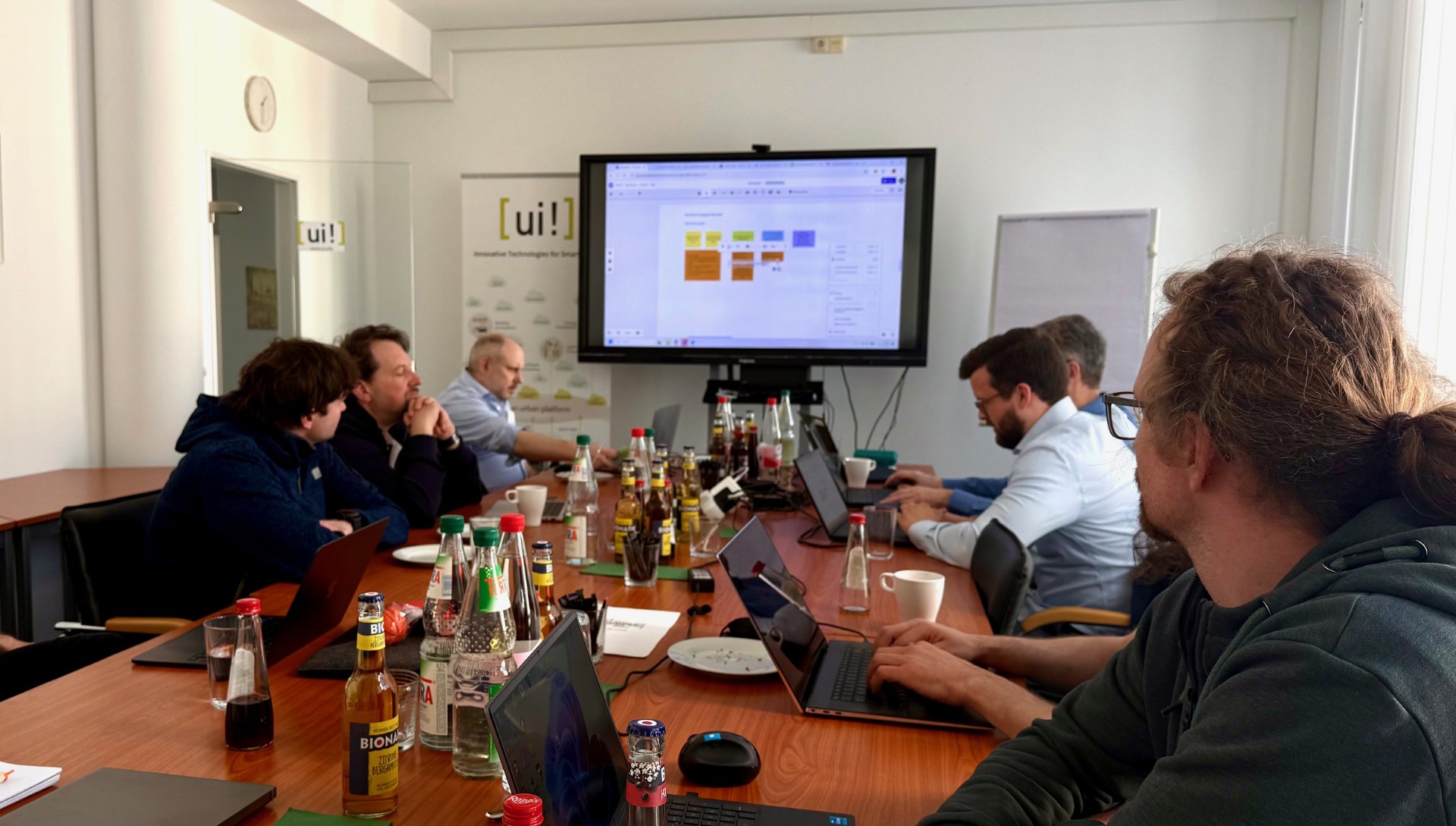
Mit dem erreichten Meilenstein befindet sich das Projekt nun auf der Zielgeraden in Richtung Abschluss Ende August 2026. Meilenstein 5 stellte einen wichtigen Schritt dar, um zentrale Ergebnisse zusammenzuführen und den weiteren Projektverlauf gezielt auszurichten. Besonders gefreut haben wir uns über die Teilnahme unserer Projektträgerin Frau Schmitz, die für eine einstündige Präsentation online zugeschaltet war. Im Anschluss fand ein Austausch mit durchweg positivem Feedback sowie eine lebhafte Fragerunde statt.</p>

<p><img src="/assets/images/workshops/darmstadt/besprechung4.jpg" alt="Impressionen aus Darmstadt" height="320" style="display:block; margin-left:auto; margin-right:auto" /></p>

<p>Im Rahmen des Treffens wurden folgende Themen präsentiert:</p>
<ul>
  <li>Die Basisplattform und die Demonstration der “15-Minuten-Stadt” zeigten, wie die zugrunde liegende Wissensgraphplattform Ressourcen in der realen Welt flexibel und einheitlich beschreibt. Die Demonstration machte deutlich, welche Point-of-Interest-Typen (POI) innerhalb bestimmter Zeitfenster erreichbar sind und wie Erreichbarkeit sowie Versorgungsqualität in urbanen Räumen datenbasiert analysiert werden können.</li>
  <li>Die Integration von Mobilitätsdaten der Universität Duisburg-Essen und von LocosLab GmbH wurde weiterentwickelt und bildet die Basis für den multimodalen Mobilitätsindex sowie die MobyDex-Plattform. Neue Daten wurden integriert, Berechnungen erweitert und Verbesserungen in einer kurzen Demonstration vorgestellt.</li>
  <li>Die Mobilitätsbedarfsanalysen des Urban Software Institute liegen als funktionsfähiger Prototyp vor, adressieren zentrale Analyse- und Entscheidungsfragen und werden anhand konkreter User Journeys veranschaulicht. Aktuell werden Ergebnisse konsolidiert und gemeinsam für die Abschlusspräsentation aufbereitet.</li>
  <li>YellowMap präsentierte einen Beratungs- und Planungs-Use-Case mit Fokus auf das Ruhrgebiet und die Universität Duisburg-Essen, basierend auf einem praxisnahen Szenario mit gemockten Studierendendaten.</li>
  <li>CISS stellte ein Radweg-Tool zur Potentialanalyse vor, das Fahrzeiten von Radverkehr und öffentlichem Verkehr vergleicht sowie vorhandene Radinfrastruktur berücksichtigt. Perspektivisch soll der Bedarf an Radwegen stärker integriert werden; ergänzende Berechnungen für Karlsruhe können bereitgestellt werden.</li>
  <li>CAS stellte vor, dass das Forschungsprojekt durch das Konsortium auf verschiedenen Veranstaltungen präsentiert wurde, darunter die Regionalkonferenz in Karlsruhe, die Smart Country Convention in Berlin und die Smart City Expo in Barcelona, sowie durch Fachbeiträge an Workshops und Austauschformaten vertreten war. Begleitend wurden Marketing- und Öffentlichkeitsmaßnahmen – darunter Website, Imagevideo, Flyer und LinkedIn-Posts – umgesetzt, um die Projektergebnisse sichtbar zu machen und weiter zu verbreiten.</li>
</ul>

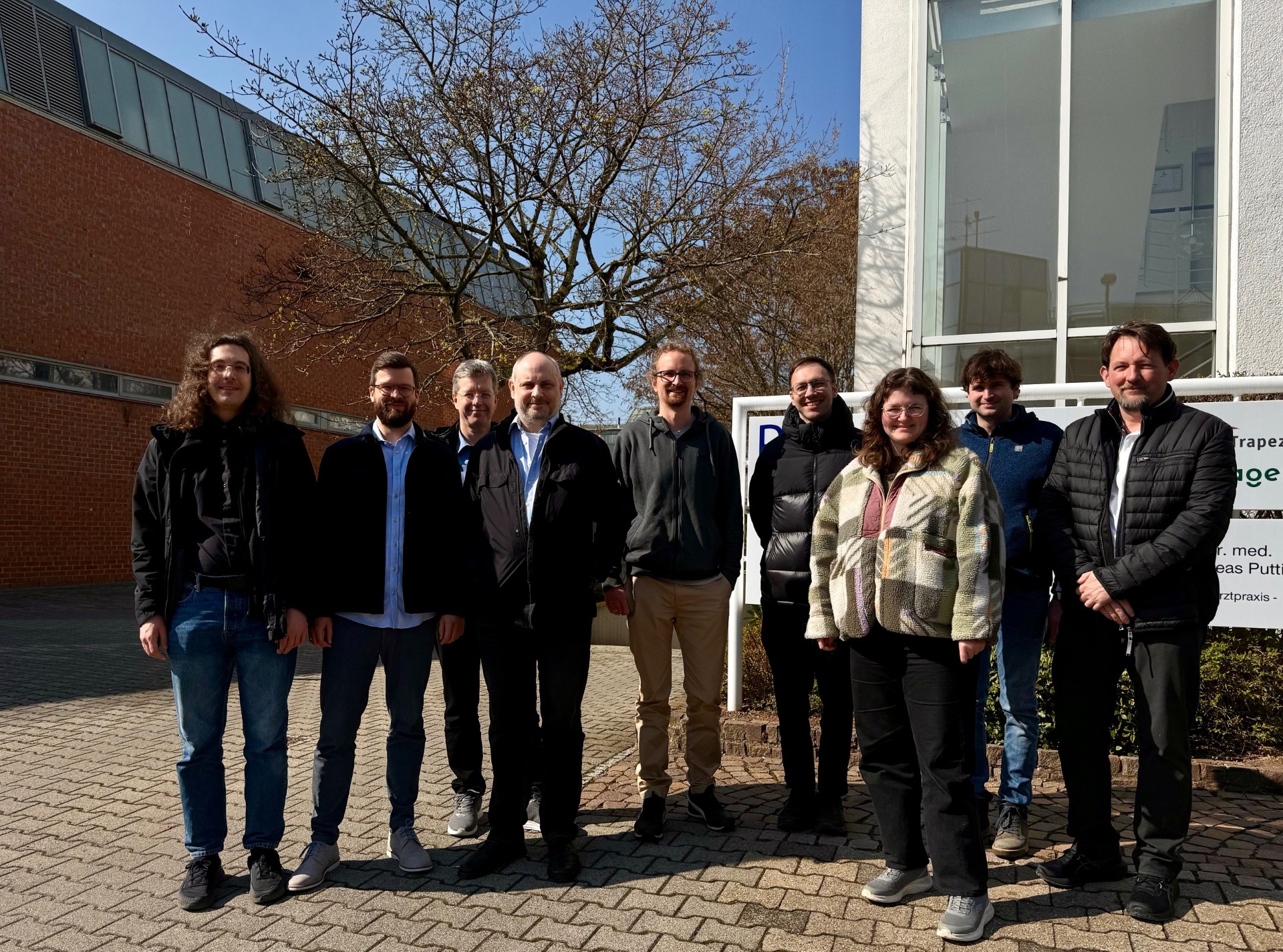
<p><img src="/assets/images/workshops/darmstadt/gruppenphoto.jpg" alt="Impressionen aus Darmstadt" height="320" style="display:block; margin-left:auto; margin-right:auto" /></p>

<p>Darüber hinaus wurden das Verwertungspotenzial der Projektergebnisse, die Integration von Daten sowie das weitere Vorgehen bei Befragungen diskutiert. Das Treffen verlief in einer konstruktiven und angenehmen Arbeitsatmosphäre, und die Zusammenarbeit der Partner unterstützt den erfolgreichen weiteren Projektverlauf.</p>]]></content><author><name></name></author><category term="news" /><summary type="html"><![CDATA[Am 18. März 2026 fand das fünfte Konsortialtreffen beim Urban Software Institute (USI) in Darmstadt statt]]></summary></entry><entry><title type="html">Successful Completion of Milestone 5</title><link href="https://mobydex.org/en/news/2026/03/18/mobydex_workshop.html" rel="alternate" type="text/html" title="Successful Completion of Milestone 5" /><published>2026-03-18T11:00:00+00:00</published><updated>2026-03-18T11:00:00+00:00</updated><id>https://mobydex.org/en/news/2026/03/18/mobydex_workshop</id><content type="html" xml:base="https://mobydex.org/en/news/2026/03/18/mobydex_workshop.html"><![CDATA[<p>On March 18, 2026, the fifth project milestone was successfully completed at the consortium partner Urban Software Institute in Darmstadt. We would like to express our sincere thanks for the excellent organization and the warm hospitality on site.
With the achievement of this milestone, the project is now on the home stretch towards completion at the end of August 2026. Milestone 5 represented an important step in bringing together key results and specifically aligning the further course of the project. We were particularly pleased about the participation of our project officer, Ms. Schmitz, who joined online for a one-hour presentation. This was followed by an exchange with consistently positive feedback and a lively Q&amp;A session.</p>

<p><img src="/assets/images/workshops/darmstadt/besprechung4.jpg" alt="Impressions from Darmstadt" height="320" style="display:block; margin-left:auto; margin-right:auto" /></p>

<p>The following topics were presented during the meeting:</p>
<ul>
  <li>The base platform and the demonstration of the “15-Minute City” showed how the underlying knowledge graph platform flexibly and uniformly describes resources in the real world. The demonstration illustrated which Point-of-Interest (POI) types are reachable within certain time windows and how accessibility and supply quality in urban spaces can be analyzed in a data-driven manner.</li>
  <li>The integration of mobility data from the University of Duisburg-Essen and LocosLab GmbH was further developed and forms the basis for the multimodal mobility index as well as the MobyDex platform. New data was integrated, calculations were expanded, and improvements were presented in a short demonstration.</li>
  <li>The mobility needs analyses of the Urban Software Institute are available as a functional prototype, address central analysis and decision-making questions, and are illustrated using concrete user journeys. The results are currently being consolidated and prepared together for the final presentation.</li>
  <li>YellowMap presented a consulting and planning use case with a focus on the Ruhr region and the University of Duisburg-Essen, based on a practical scenario with mocked student data.</li>
  <li>CISS presented a cycle path tool for potential analysis that compares travel times of cycling and public transport and takes existing cycling infrastructure into account. In the future, the demand for cycle paths is to be more strongly integrated; supplementary calculations for Karlsruhe can be provided.</li>
  <li>CAS reported that the research project has been presented by the consortium at various events, including the Regional Conference in Karlsruhe, the Smart Country Convention in Berlin, and the Smart City Expo in Barcelona, as well as through specialist contributions at workshops and exchange formats. Accompanying this, marketing and public relations measures – including the website, image video, flyers, and LinkedIn posts – were implemented to make the project results visible and disseminate them further.</li>
</ul>

<p><img src="/assets/images/workshops/darmstadt/gruppenphoto.jpg" alt="Impressions from Darmstadt" height="320" style="display:block; margin-left:auto; margin-right:auto" /></p>

<p>In addition, the exploitation potential of the project results, the integration of data, and the next steps regarding surveys were discussed. The meeting took place in a constructive and pleasant working atmosphere, and the collaboration among the partners supports the successful continuation of the project.</p>]]></content><author><name></name></author><category term="news" /><summary type="html"><![CDATA[On March 18, 2026, the fifth consortium meeting took place at the Urban Software Institute (USI) in Darmstadt]]></summary></entry><entry><title type="html">Neues Jahr, neue Schritte bei Moby Dex</title><link href="https://mobydex.org/news/2026/01/02/happy_new_year.html" rel="alternate" type="text/html" title="Neues Jahr, neue Schritte bei Moby Dex" /><published>2026-01-02T11:00:00+00:00</published><updated>2026-01-02T11:00:00+00:00</updated><id>https://mobydex.org/news/2026/01/02/happy_new_year</id><content type="html" xml:base="https://mobydex.org/news/2026/01/02/happy_new_year.html"><![CDATA[<p>Wir starten motiviert ins Jahr 2026!
In den kommenden Monaten werden wir gemeinsam mit unseren Partnern die Plattform Moby Dex weiter ausbauen, neue Funktionen implementieren und die ersten Demonstratoren unter realen Bedingungen testen.
Wir freuen uns auf spannende Fortschritte und Einblicke, die wir in diesem Jahr mit Ihnen teilen werden.</p>]]></content><author><name></name></author><category term="news" /><summary type="html"><![CDATA[Wir starten motiviert ins Jahr 2026!]]></summary></entry><entry><title type="html">New Year, New Steps at Moby Dex</title><link href="https://mobydex.org/en/news/2026/01/02/happy_new_year.html" rel="alternate" type="text/html" title="New Year, New Steps at Moby Dex" /><published>2026-01-02T11:00:00+00:00</published><updated>2026-01-02T11:00:00+00:00</updated><id>https://mobydex.org/en/news/2026/01/02/happy_new_year</id><content type="html" xml:base="https://mobydex.org/en/news/2026/01/02/happy_new_year.html"><![CDATA[<p>We are starting the year 2026 motivated!</p>

<p>In the coming months, together with our partners, we will further expand the Moby Dex platform, implement new features, and test the first demonstrators under real-world conditions.</p>

<p>We are looking forward to exciting progress and insights that we will share with you this year.</p>]]></content><author><name></name></author><category term="news" /><summary type="html"><![CDATA[We are starting the year 2026 motivated!]]></summary></entry></feed>